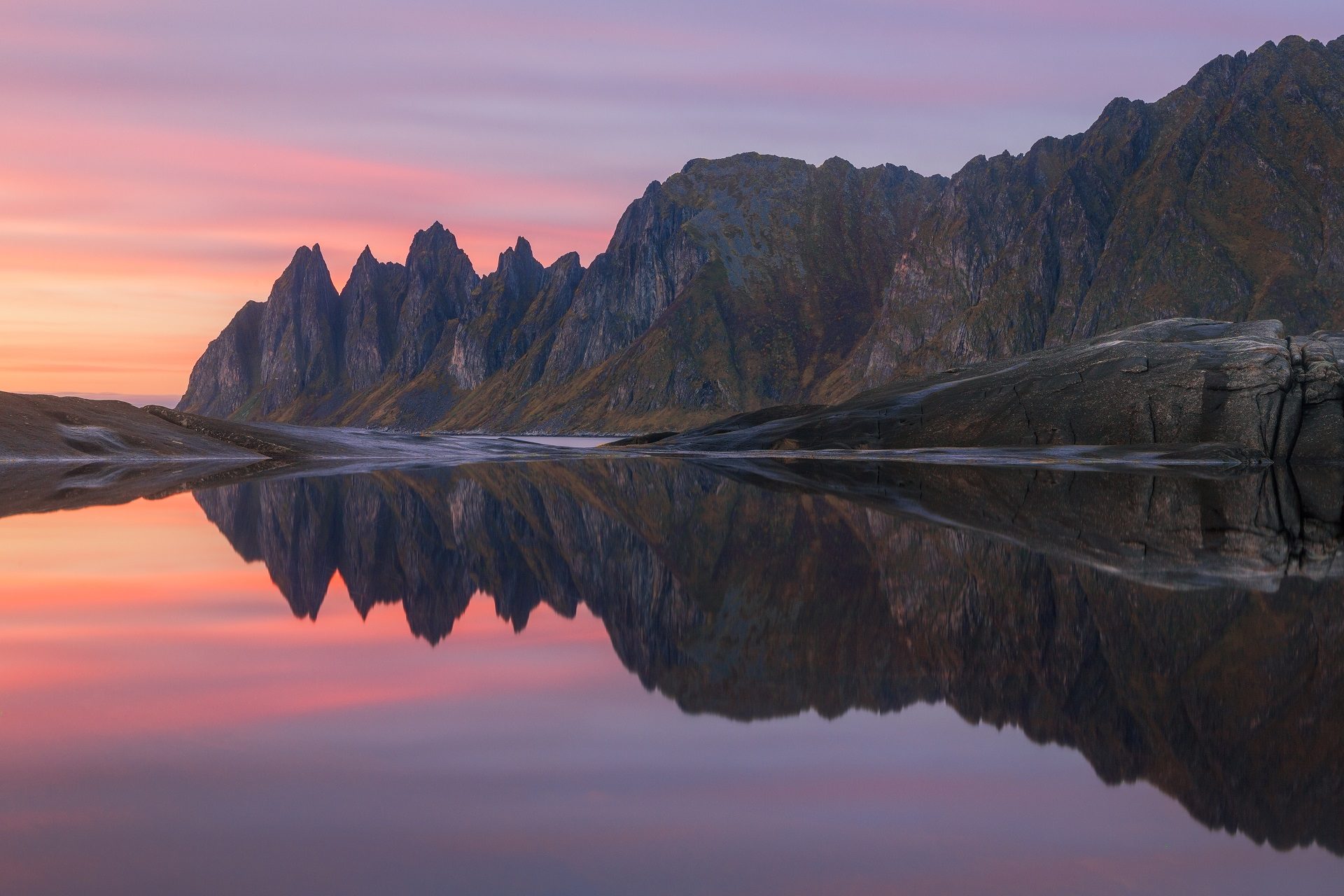
Lofoten. 25 seconds exposure, on tripod.

When we discuss reflection in landscape photography, it is often closely associated with symmetrical composition. Symmetry is perhaps the easiest and most universally appealing compositional approach, as it naturally creates a sense of balance and harmony. It can be found almost everywhere, sometimes in predictable settings and sometimes in unexpected places, ranging from small puddles to quiet ponds, expansive lakes, and even the open ocean. The ideal condition for achieving symmetry through reflection is complete stillness. When there is little or no wind, the absence of ripples and waves allows reflections to appear clean and well defined. Generally, the smaller the body of water, the easier it is to achieve a near perfect reflection.

Lofoten. 60 seconds exposure, on tripod.
Senja Island. 240 seconds exposure, on tripod.

I have lost count of how many times I have photographed reflections and symmetrical compositions throughout my life. Whenever symmetry presents itself, I almost never let it go. This is simply because symmetry has a timeless appeal in photography. It speaks directly to how our brains interpret the world. Human perception is naturally drawn to patterns, and symmetry is one of the most fundamental patterns we encounter in nature. When we see a symmetrical image, our minds process it quickly and effortlessly, creating a feeling of balance, order, stability, clarity, and calm.

Senja Island. 120 seconds exposure, on tripod.
Canadian Rockies. 6 seconds exposure, on tripod.

This sense of balance is one of the key reasons symmetrical photographs are so visually satisfying. When both sides of an image echo each other, the composition gains internal harmony. The viewer is not distracted by competing elements. Instead, the eye moves smoothly along the central axis, allowing the photograph to deliver a strong and unified message. The result is a sense of serenity, almost as if the image resolves itself the moment it is seen.

Ilulissat Icefjord in Greenland. Handheld. With very calm water.
Ilulissat Icefjord in Greenland. Handheld. With ripples but reflections still visible.

Symmetry also carries deeper aesthetic power. Because it often represents perfection or an idealized sense of order, symmetrical compositions can feel elegant and refined. Think of the proportional features of the human face, which we instinctively associate with beauty. It brings together visual order, emotional calm, and a sense of universal beauty.

Canadian Rockies. With frozen ice and snow covering in the mid-ground, I photographed from as low a position as possible to minimize the appearance of mid-ground.
Lofoten. With ripples the mid-ground, I photographed from ground level to minimize the appearance of mid-ground.

From a technical standpoint, symmetry is also one of the simplest compositional approaches. Pure symmetry, without foreground elements, leading lines, or additional visual anchors, creates minimalist scenes where simplicity itself becomes the subject. One important consideration is camera height or shooting level. In most cases, height does not matter unless there are distracting elements between the main subject and its reflection. In such situations, shooting at ground level or as low as possible can help minimize midground distractions.

Cypress Swamp in Texas. Photographed from a boat using a very tall tripod, the Fotopro X-75C with a maximum height of 8.5 feet, this setup allowed me to stabilize the camera and capture a long exposure of 13 seconds.
Cypress Swamp in Texas. Photographed from a boat using a very tall tripod, the Fotopro X-75C with a maximum height of 8.5 feet, this setup allowed me to stabilize the camera and capture a long exposure of 15 seconds.

Water is rarely perfectly calm. Long exposures from a few seconds up to ten or even twenty seconds can help smooth the surface, depending on the intensity of the ripples. In calm conditions, a few seconds on a tripod may be enough to render the water perfectly smooth. When there are more pronounced ripples but the reflection remains visible, a ten to twenty second exposure can soften the water while preserving the mirrored image. The key requirement is that nothing in the frame is moving, otherwise it will blur.

Svalbard. Handheld. Very calm water.
Antarctica. Handheld. Ripples changes, I took multiple shots to get one with better pattern of ripples.


Sometimes long exposure is not an option, such as when photographing from a boat. In those cases, I take multiple images and select the frame with the most pleasing ripple pattern. Even imperfect symmetry can still be powerful when the balance and reflection feel right.

In the end, symmetrical composition is not about technical perfection but about awareness. By recognizing moments of balance and stillness, and responding to them with simplicity and intention, photographers can create images that feel timeless, calm, and deeply resonant.