

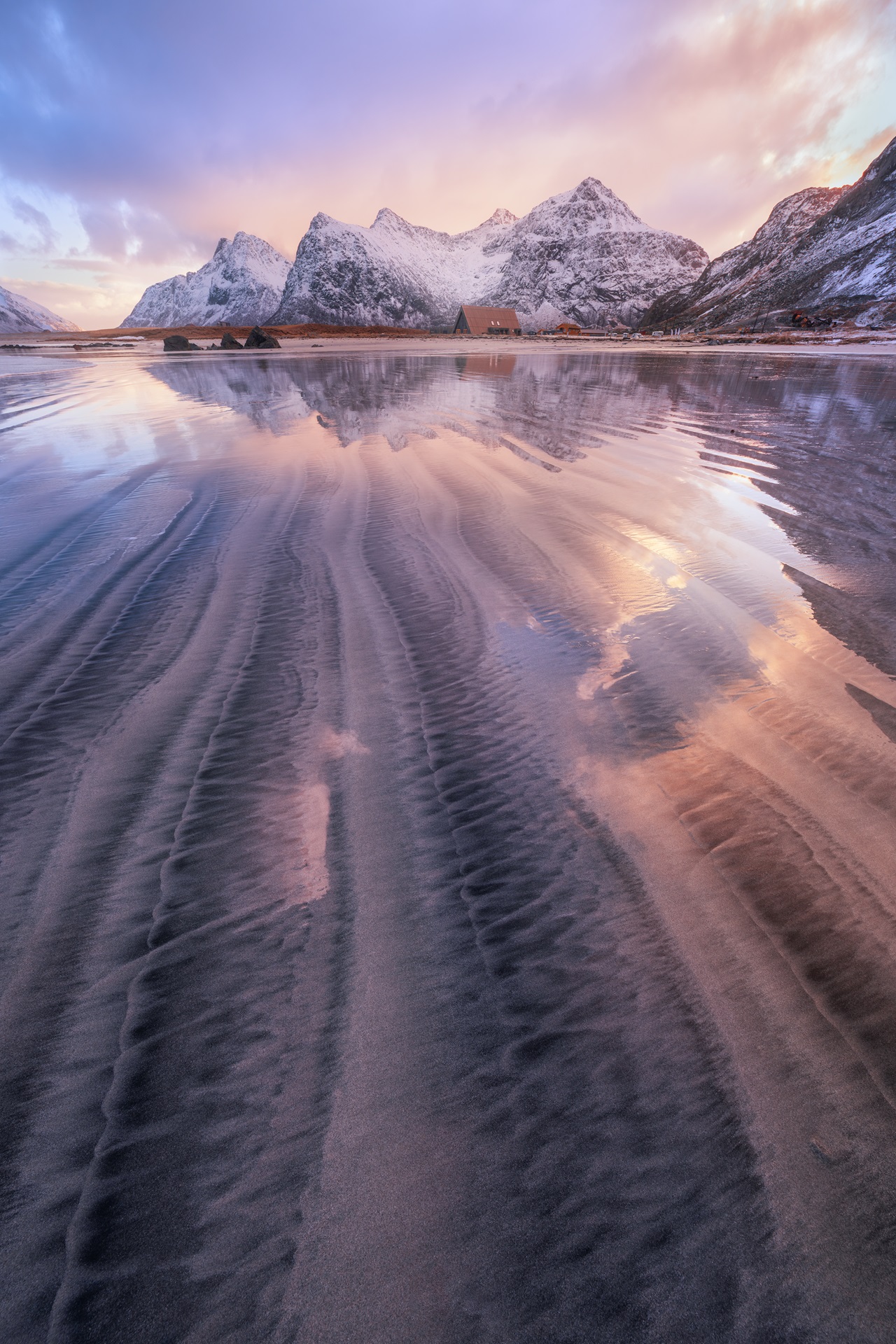
Some landscapes reveal themselves instantly. Others invite you to slow down and explore them layer by layer. This image, photographed in Skagsanden beach in Lofoten, belongs to the second kind. At first glance, the soft colors of the Arctic sky and the dramatic mountains catch the eye, but the real strength of the photograph lies in how the composition quietly guides the viewer through the scene.
FOREGROUND
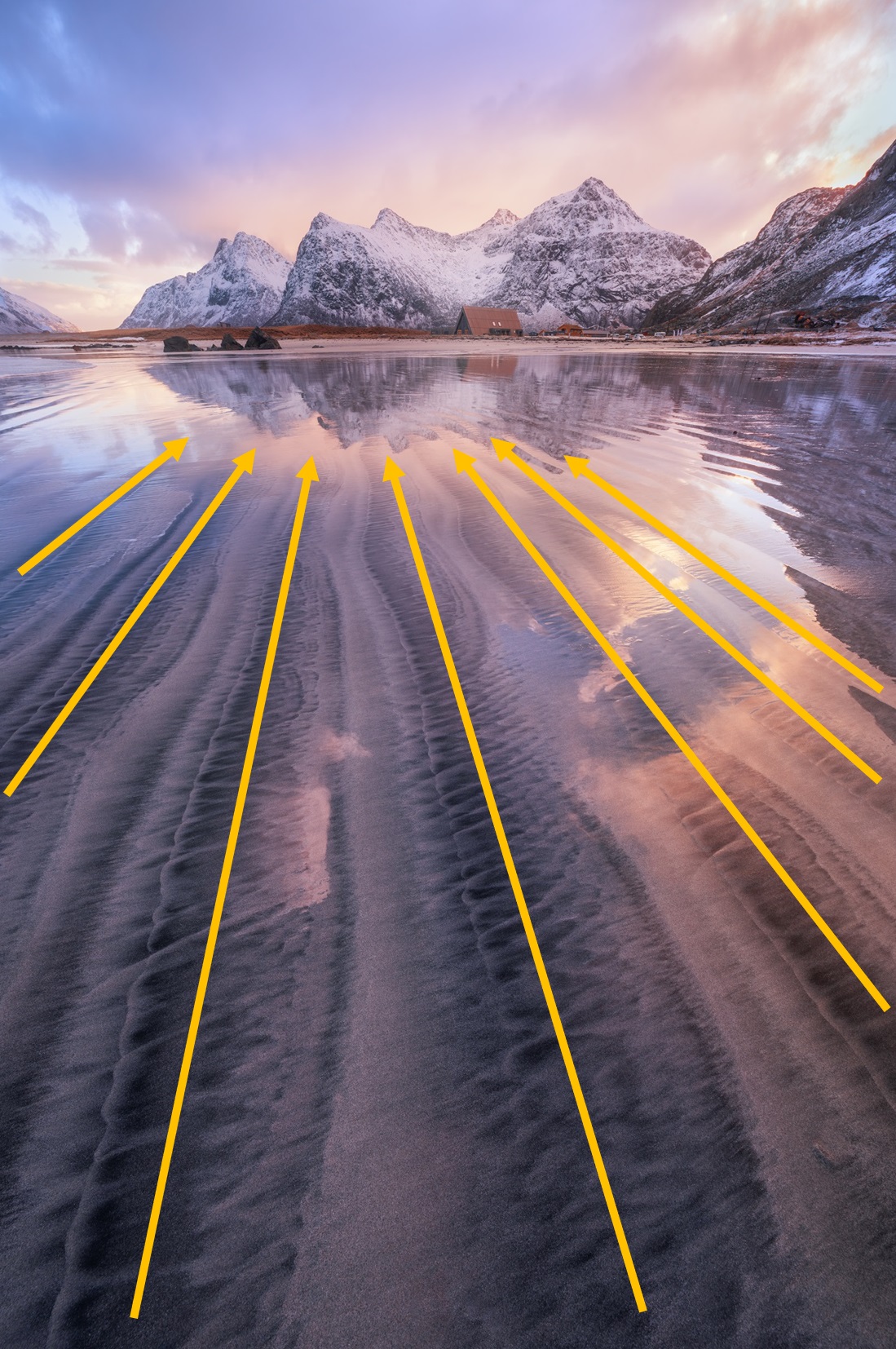
The story of this image begins in the foreground. The ridges in the wet sand form natural lines that stretch from the bottom of the frame toward the distant mountains. These lines are created by the retreating tide, but in the photograph they become something more than just texture. They act as visual pathways that lead the viewer’s eye deep into the image. Each ridge gently converges toward the horizon, creating a strong sense of perspective and depth. Instead of looking at a flat beach, the viewer feels drawn into the landscape.
You can easily find these sand ridges during low tide, but it can be challenging to find a group of lines that work together so harmoniously and naturally converge toward the distant subject, the cabin and the mountains. It takes time to explore and discover this alignment. The best opportunity is during low tide at sunrise, when there are fewer people walking across the beach and leaving footprints everywhere. At sunset, it can be much harder to find a clean foreground.
REFLECTION & BALANCE
Between these sand ridges lies a thin layer of water, turning the beach into a subtle mirror. The reflections of the cabin, mountains, and sky appear on the wet surface, visually linking the foreground with the sky above. Reflection brings symmetry, and symmetry brings a sense of balance and harmony to the composition. The dynamic patterns of the sand in the foreground create movement and energy, while the calm reflection introduces stability. These two elements: one active and textured, the other smooth and quiet, balance each other beautifully, making the image both visually engaging and restful to observe.
Another subtle strength of the reflection is how it softens the transition between elements. The mountains appear twice, once in their solid, textured form above the horizon, and again as a softer, more abstract version in the wet sand. This dual presence adds visual richness. The real mountains provide structure and power, while their reflections introduce a painterly quality that enhances the mood of the scene.
THE ANCHOR
In the middle of the scene sits a small cabin. It is easy to overlook at first, but compositionally it plays a critical role. Without the cabin, the landscape would still be beautiful, but it might feel vast and empty. The cabin provides a visual anchor, a place where the viewer’s eye can rest after traveling along the leading lines of the sand. It also introduces scale. Against the towering mountains behind it, the cabin reminds us of the immense size and power of the surrounding landscape.
THE BACKDROP
The mountains themselves form a dramatic backdrop. Their jagged peaks create rhythm across the horizon, each summit slightly different from the next. Snow clings to their slopes, catching the soft light of the sky. These peaks not only add grandeur to the scene but also stabilize the composition by forming a strong visual boundary at the top of the frame.
LIGHTS AND EMOTIONS
Light and color play an equally important role. The sky is filled with soft pastel tones, subtle pinks, warm oranges, and gentle blues. These colors come from the magical light of sunrise, when Arctic light is delicate and fleeting. Understanding the direction of light is essential. In this case, the light comes from behind the mountains during sunrise, creating a soft backlit glow in the clouds. Being at the right place at the right time is crucial to capture this moment. Because these tones are reflected in the wet sand, the entire image shares a cohesive color palette. Nothing feels out of place; every element belongs to the same quiet moment.
TECHNIQUES
Another important decision in creating this photograph is the camera position. A lower angle would compress the lines, exaggerate the nearest ridges, and include too much sky. In this situation, a slightly higher camera position works better. It elongates the lines and allows the sand ridges to stretch deeper into the frame, dominating the foreground. The sky does not need to occupy a large portion of the image; the strength of the composition lies in the patterns of the beach.
WHAT IF…
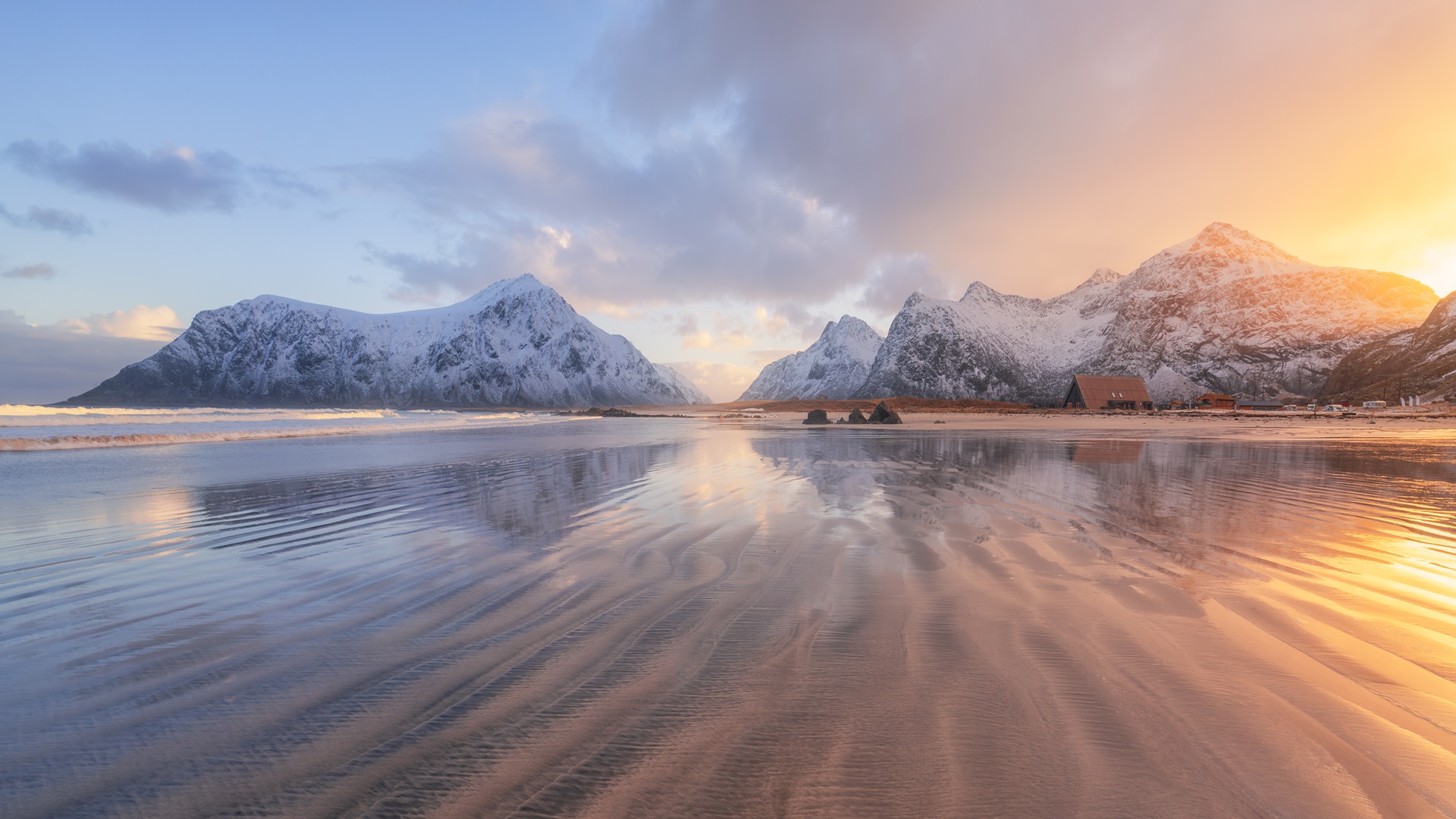
What if the image were composed horizontally? As shown in these two examples, one emphasizes the foreground, while the other emphasizes symmetry. In either case, it would still convey the vastness and grandeur of the landscape. However, the visual dynamics would shift. A horizontal frame encourages the viewer to scan across the scene, emphasizing scale and openness. In doing so, the leading line becomes less dominant, losing its strength as a directional element that guides the eye into the image. As a result, the composition feels more static and observational, rather than a guided visual journey. The impact of the image is therefore reduced, as the leading line plays a critical role in its structure and flow.

END NOTE
Ultimately, the success of this image comes from how all these elements work together. The foreground patterns guide the eye, the reflections unify the colors, the cabin provides a focal point, and the mountains give the scene structure and scale. Where you place your camera is crucial. Finding the perfect spot, not even slightly higher or lower, makes all the difference. And most importantly, you must arrive at the right moment: low tide at sunrise.
The viewer is not simply looking at a landscape. The composition invites them to step into it, follow the lines of the shore, and stand quietly beneath the mountains of Lofoten.
I have been photographing Skagsanden since 2016, returning every winter during my photo workshops. I don’t take out my camera every time, yet I have still created many images that I truly like. After nearly a decade, this remains my favorite photograph from Skagsanden so far.