

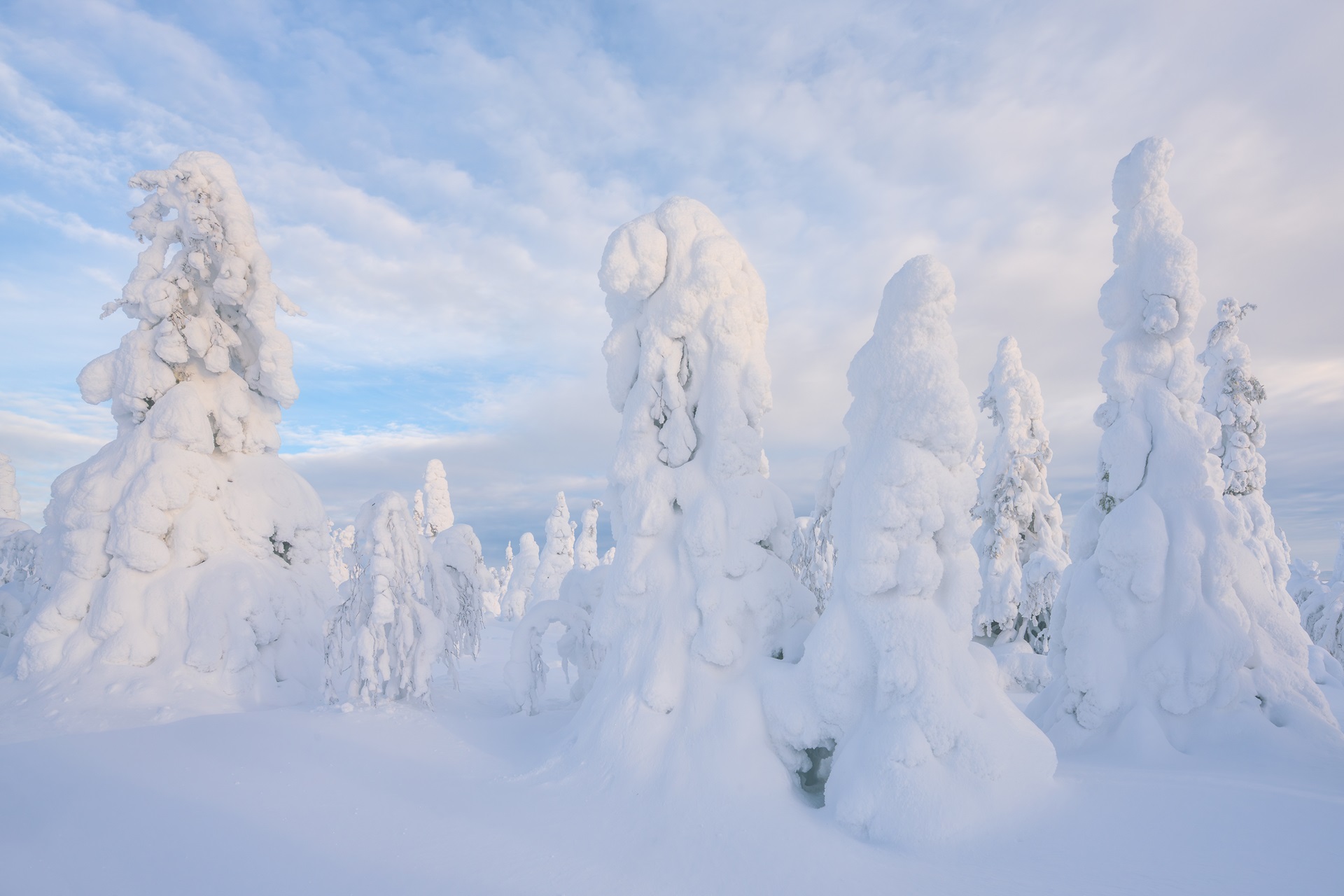
Some images impress instantly. Others work more quietly, revealing their strength the longer you stay with them. This image from Finland Lapland belongs firmly to the latter category, and that is precisely why it is a strong one.
If you have ever imagined stepping into a frozen fairy tale, take a walk through a tykky forest. Tykky is the Finnish term for trees completely encased in frost and snow during winter. The result is nothing short of extraordinary.
At its core, the photograph succeeds because of its subject. Tykky trees are instantly recognizable yet endlessly unfamiliar. Each form is wrapped in snow so completely that it transcends botany and becomes sculpture. The trees feel almost human or mythical, sentinels rather than objects, and that anthropomorphic quality invites interpretation. Viewers don’t just see trees; they begin to read posture, presence, and personality. Some stand firmly, others lean gently, some recede into silence. The forest becomes a cast of characters.
Light plays a crucial role in allowing this transformation to happen. The soft, diffused winter light eliminates harsh shadows and preserves delicate snow textures that would otherwise be lost. Subtle blue tones in the sky gently separate the background from the white foreground, preventing the image from collapsing into flatness. This restraint in light handling is technically demanding in white-on-white conditions, yet here the tonal separation is just enough to keep every form readable. You don’t need dramatic light to create a powerful image.
Depth is handled with equal care. Foreground, midground, and background are clearly layered, guiding the eye inward. Larger tykky trees anchor the frame, while smaller forms recede into the distance, creating scale without explanation. There is no human figure or familiar object to define size, and that ambiguity becomes a strength. Are these trees small and intimate, or towering and monumental? The image never answers, and that uncertainty pulls the viewer deeper into the scene, shifting it from documentary toward the surreal.
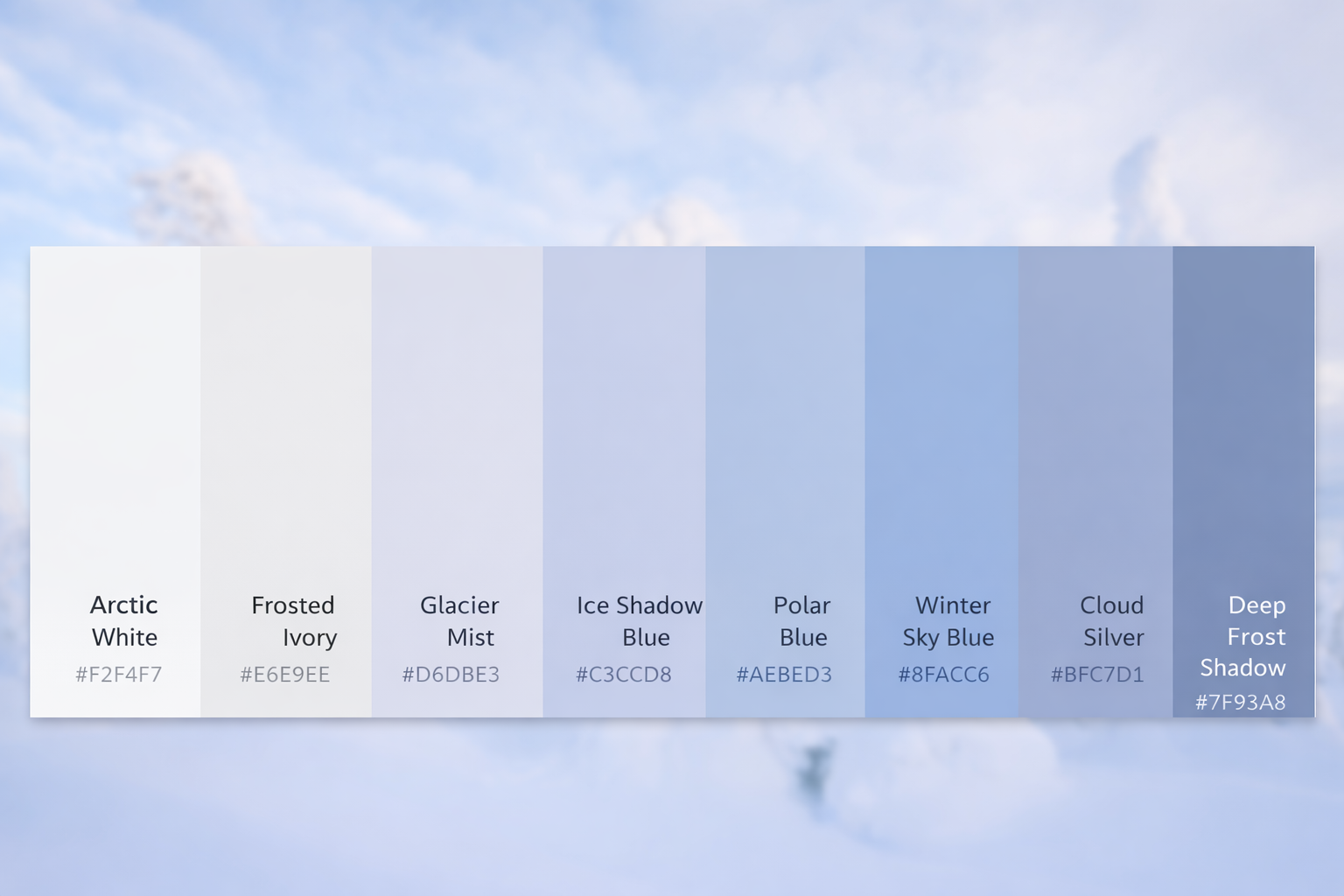
Overall color is characterized by high-key dominant whites, cool blue undertones, very low saturation, minimal warm contrast, and smooth tonal transitions. This restrained palette explains why the image feels calm and ethereal, it remains within a narrow cool spectrum, free from harsh contrast.
Color restraint reinforces this effect. Whites, soft blues, and faint grays form a cohesive palette that eliminates distraction. Nothing competes for attention. This visual harmony amplifies the Arctic mood and enhances the sense of cold, silence, and stillness.
Rhythm emerges through repetition: vertical forms rise calmly across the frame, guiding the eye without rushing it. Though the shapes repeat, no two trees are identical, keeping the image dynamic rather than monotonous.
Emotionally, the image carries a quiet power. It feels isolated, otherworldly, and timeless, like a frozen fairy tale paused mid-breath. There is no drama in the conventional sense: no storm, no burning sunset, no aurora tearing across the sky. Instead, the absence of spectacle becomes the statement. The quietness itself is the subject. This kind of restraint marks the difference between postcard imagery and fine-art storytelling. The composition supports this emotional tone. The frame is balanced but not symmetrical, allowing the eye to move naturally from left to right and back again.
Psychologically, the image offers calm. There is no tension, no visual conflict, no aggressive contrast. Viewers don’t just look at the image; they slow down with it. That slowing is intentional, reinforced by the image’s “slow tempo.” Nothing rushes the eye. Vertical forms rise gently, curves soften movement, and the pacing invites lingering.
Texture quietly holds everything together. Snow is notoriously easy to over-process, yet here it remains nuanced and tactile. Powdery surfaces, compacted layers, and gentle curves are preserved with care. The cold is communicated without brutality. Rather than feeling hostile, the snow appears protective, wrapping the trees like insulation. This reframing makes the Arctic feel intimate rather than alien and taps into a deep human instinct for shelter and guardianship.
Narratively, the image explains very little, and that is its strength. There are no footprints, no structures, no technology, no visual trends anchoring it to a specific era. It leaves room for stories: a frozen forest guarding secrets, silent Arctic sentinels, a world paused mid-breath. Images that allow interpretation tend to stay with viewers longer, not because of what they show, but because of what they suggest.
People tend to remember images that feel rare, feel calm yet strong, and feel like stepping into another world. After looking away, it’s not the details that linger, but the feeling. That lingering sensation, of silence made visible, of calm made tangible, is the mark of a mature image.
Ultimately, the reason I like this image is simple and profound: it doesn’t shout, it simply invites.