

Senja is the second largest island in Norway, surpassed only by Hinnøya — excluding the Svalbard archipelago. Often described as “Norway in miniature,” Senja offers a diverse mix of oceans, mountains, fjords, beaches, forests, and quaint fishing villages, all accessible within a few hours’ drive.
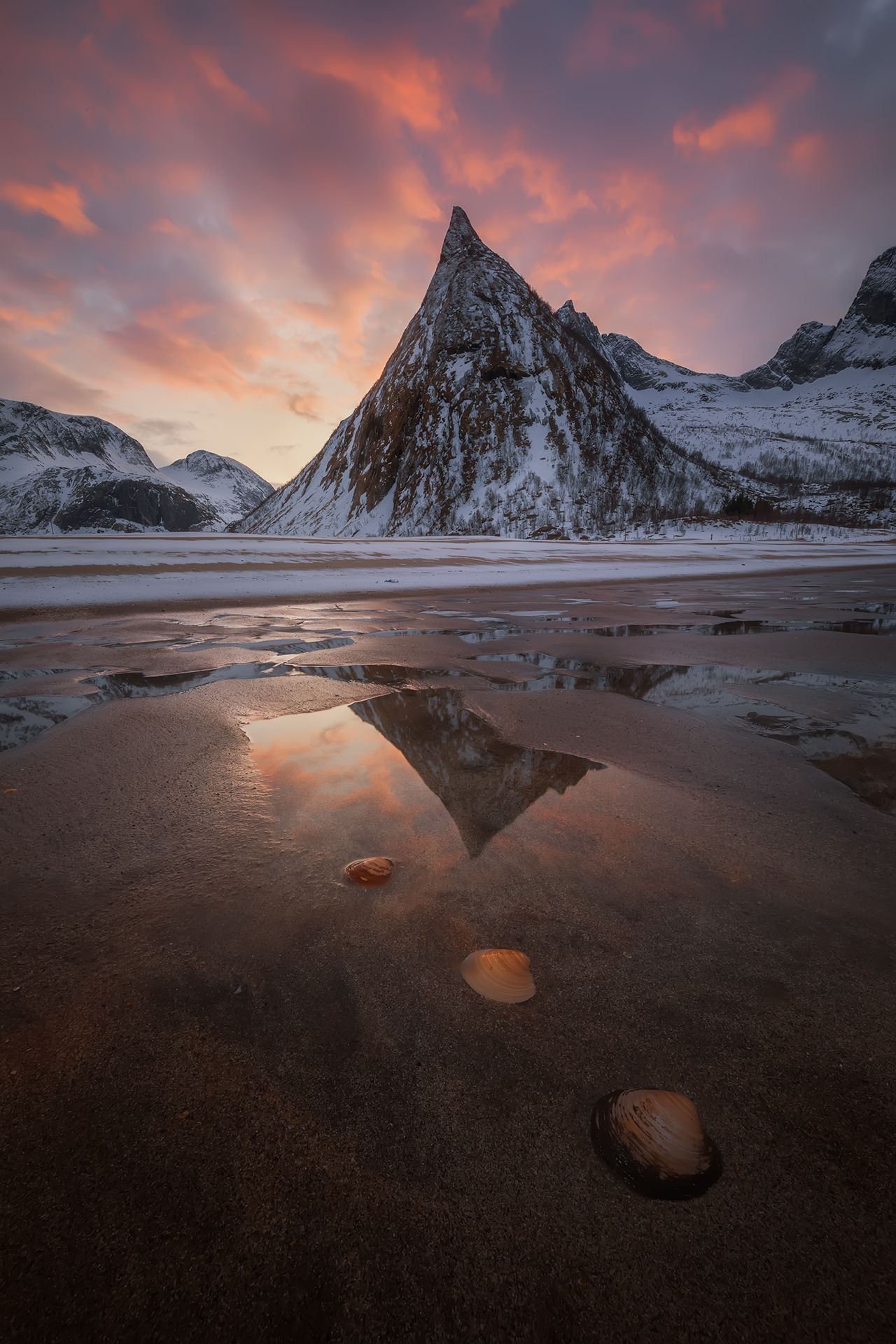
This image features the beach at Ersfjord, a stunning and well-loved spot on Senja Island. The view toward the ocean is flanked by mountains, creating a dramatic backdrop – This is the most frequently photographed view at this location. Interestingly, the view toward the main road, there’s a mountain resembles a witch’s hat when viewed from certain angles. This teaches us an important lesson: even in well-known locations, it’s worthwhile to explore your surroundings. Sometimes, the most captivating views are those that are less commonly photographed.
We planned our visit for this morning, knowing it was low tide, which would likely reveal more interesting foreground elements, such as patterns in the sand. During our early February visit to Senja, the temperatures remained low and there was significant snowfall. The mountains, adorned with snow, appeared even more stunning as the melting snow formed small patches of water.
The beach is dotted with multiple patches of water reflecting the mountain, complemented by intricate sand patterns and scattered seashells that could serve as foreground elements. Standing closer to the water, I could use the wave movement as both a foreground and a leading line. Although the scene offers plenty of options, incorporating all these elements into one frame could result in a cluttered composition. I decided to focus on the reflections, an irresistibly magical component in any composition that one must seize when the chance arises. However, I needed another element that would harmonize with the overall composition, ideally a strong leading line. After inspecting several patches of water aligned with the mountain, I found no suitable sand pattern in the same frame. As time pressed on and the golden hour approached, I quickly decided to place three small seashells along a diagonal line. These shells not only enhance the leading line but also guide the viewer’s gaze directly into the mountain reflection.
Positioning the camera at the right height poses a challenge. Setting it too low enhances the reflection but obscures the leading line. Conversely, a higher position reveals the leading line but loses the reflection. Finding the perfect height for the right balance is the key for perfect composition.
The seashells are small, necessitating a closer camera setup. Consequently, I need to use focal stacking to ensure sharpness throughout the scene.
After wrestling with the composition, the day’s best light arrived. Although the sun was obscured by the mountain, it illuminated and painted the clouds above. I captured several shots, each with different cloud patterns, and found that this one worked the best – the clouds seemed to radiate outward from the mountain. The warm hues of the golden hour contrasted strikingly with the cool tones and wintery feel of the landscape.
Why did I place the mountain in the center of the frame instead of adhering to the rule of thirds? When aiming to highlight the magnificence, stability, and importance of the main subject, a central placement often proves more effective than an off-center one. Consider how an Olympic gold medalist stands at the center of the podium, or how a throne is positioned at the heart of a throne room. The rule of thirds isn’t a one-size-fits-all solution; sometimes, breaking this rule better serves the image.
All the elements in this image are arranged to form a coherent and continuous path. The seashells guide the viewer’s eyes towards the reflection and the main subject, the witch hat mountain. The radiating cloud pattern then directs the viewer’s gaze in a divergent manner. This technique is known as “visual path” or “visual continuity,” and it helps guide the viewer’s exploration of the image.